

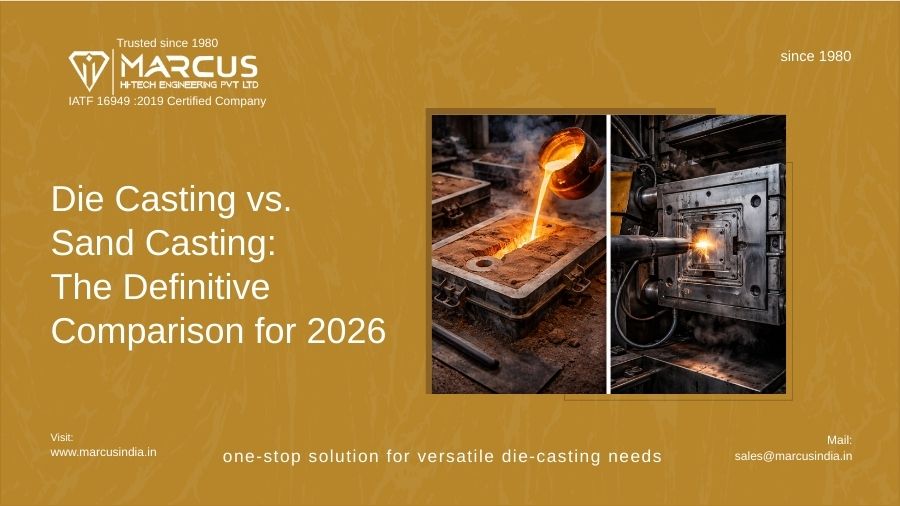
When it comes to metal fabrication, the debate of die casting vs. sand casting is central to every manufacturing strategy. Both methods are essential in modern industry, yet they serve vastly different purposes regarding volume, precision, and budget.
This guide breaks down die casting vs. sand casting vs. metal casting at large, helping you choose the right process for your specific application.
1. Die Casting vs. Sand Casting: Pros and Cons
Understanding the trade-offs between these two methods is the first step in optimizing your production line.
The Case for Die Casting
The die casting process uses permanent steel molds and high-pressure injection.
- Pros: Exceptional dimensional accuracy, smooth surface finishes, and the ability to cast extremely thin walls (1.5 mm).
- Cons: Extremely high upfront tooling costs and limited to non-ferrous metals like aluminum and zinc.
The Case for Sand Casting
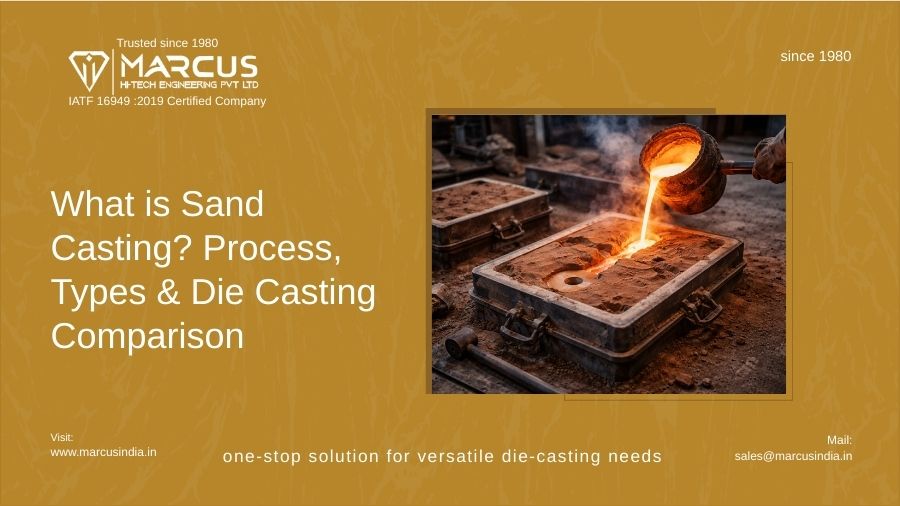
Sand casting is a versatile, non-permanent mold process.
- Pros: Very low tooling costs, capable of producing massive parts (up to several tons), and compatible with almost all metals (iron, steel, bronze).
- Cons: Rougher surface finish (requires more machining) and lower dimensional consistency over long runs.
2. Sand Casting vs. Die Casting vs. Investment Casting
While die casting vs. sand casting are the most common, investment casting (lost-wax) is the middle ground for high-complexity parts.
- Sand Casting: Best for large, heavy, or low-volume industrial parts.
- Die Casting: Best for high-volume, lightweight precision components like automotive housings.
- Investment Casting: Best for intricate, high-value parts (like turbine blades) that require the precision of die casting but use metals like stainless steel.
3. Die Casting vs. Sand Casting Cost Analysis
The “winner” in the die casting vs. sand casting cost battle depends entirely on your production scale.
Cost Factor | Sand Casting | Die Casting |
Tooling/Setup | Low ($) | High ($) |
Labor per Part | High (Manual intensive) | Low (Automated) |
Material Waste | Moderate | Very Low |
Economic Volume | 1 – 1,000 units | 5,000+ units |
Pro Tip: If you only need 100 units, sand casting is significantly cheaper. If you need 50,000 units, the high speed of die casting makes it the more profitable choice despite the initial mold cost.
4. Engineering Comparison: Die Casting vs. Forging
If your part requires extreme structural integrity, you might look beyond die casting vs. sand casting toward forging.
- Forging creates a superior grain flow, offering the highest strength for safety-critical parts.
- Die Casting allows for much more complex internal geometries and “near-net-shape” designs that forging cannot achieve.
5. When to Choose Centrifugal Casting
In any discussion of die casting vs. sand casting vs. metal casting, we must mention centrifugal casting. This process is the gold standard for cylindrical components (pipes, bushings). By spinning the mold, the process forces impurities to the center, creating a denser, more reliable outer wall than either sand or die casting can provide for hollow shapes.
6. Manufacturing at Marcus Hi-Tech
At Marcus Hi-Tech, we manage the complexities of the die casting process and sand casting across our global facilities in India (Chennai, Coimbatore, Pune), China, and Vietnam.
Whether you are weighing sand casting vs. investment casting for a new prototype or ready to scale with high-pressure die casting, our engineering team ensures your tolerances and alloy specifications (A380, ADC12) are met with 100% precision.